Private Biology Tutor Online with AI
Private Biology lessons with an AI teacher: your child talks with the teacher out loud, and the teacher explains and draws on a shared board, step by step, following what they're learning in class.
Teacher: Noa
- Course updated 11/2026
- Hebrew, and 5 more languages
- 1 level: High School (Grades 10–12)
- 24 lessons · about 15 hours of lessons
Biology
Private Biology lessons with an AI teacher: your child talks with the teacher out loud, and the teacher explains and draws on a shared board, step by step, following what they're learning in class.
24 lessons · 6 modules · Live private lesson with the teacher on the board
What you'll learn
- The Human Body – Systems, Regulation and Coordination
- The Cell – Structure, Composition and Energy
- Genetic Material and Heredity
- Ecology and Evolution
- Deepening Topics (Part D)
- Exam Technique – Questionnaire 043381
Related topics
What's included
- Live 1:1 lessons with an AI tutor on a shared board
- 15 hours of live one-on-one lessons
- 24 lessons on a shared board, each with a clear goal
- Practice and a understanding check in every lesson
- A summary after every lesson, saved in the history
- A completion certificate for each level
- Computer, tablet or phone
- Hebrew, plus 5 more languages
Course plan
1 level · 6 modules · 24 lessons · 14 hr 40 min total
בגרות 5 יח"לBiology – Bagrut 5 Units (Theory Exam 043381)6 modules • 24 lessons • 14 hr 40 min
Mapped to exam: בגרות ביולוגיה 5 יח"ל – שאלון 043381 (בחינה עיונית, 55%)
The Human Body – Systems, Regulation and Coordination8 lessons • 4 hr 45 min
- 1Human Body Overview: Levels of Organization and HomeostasisTrial lessonabout 30 min
- 2Respiratory System: Gas Exchange and Oxygen Transportabout 35 min
- 3Circulatory System: Heart, Vessels and Capillariesabout 40 min
- 4Excretory System: The Kidney and the Nephronabout 35 min
- 5Defense Systems: Innate and Acquired Immunityabout 35 min
- 6Nervous System: From Neuron to Reflexabout 35 min
- 7Hormonal System and the Liver: Blood Sugar Regulationabout 40 min
- 8Human Reproduction and Hormonal Regulationabout 35 min
The Cell – Structure, Composition and Energy5 lessons • 3 hr
- 9Characteristics of Life and Cell Structureabout 35 min
- 10The Chemical Composition of the Cellabout 35 min
- 11Transport Across the Cell Membraneabout 35 min
- 12Enzymes and ATP: The Basis of Metabolismabout 35 min
- 13Cellular Respiration and Photosynthesisabout 40 min
Genetic Material and Heredity4 lessons • 2 hr 30 min
- 14Genetic Material and the Cell Cycle: DNA, Replication, Mitosisabout 35 min
- 15From DNA to Protein, and Mutationsabout 40 min
- 16Meiosis and Mendelian Inheritance: Monohybrid Crossesabout 35 min
- 17Dihybrid Crosses, Sex Linkage and Pedigreesabout 40 min
Ecology and Evolution3 lessons • 1 hr 55 min
- 18Environmental Factors and Adaptation to Habitatsabout 35 min
- 19Interactions and Energy and Matter Flow in Ecosystemsabout 40 min
- 20Evolutionary Processes and Human Impact on the Environmentabout 40 min
Deepening Topics (Part D)3 lessons • 1 hr 50 min
- 21Deepening: Bacteria and Viruses in the Human Bodyabout 35 min
- 22Deepening: Comparative Physiology – From Unicellular to Mammalsabout 35 min
- 23Deepening: Gene Expression Control and Genetic Engineeringabout 40 min
Exam Technique – Questionnaire 0433811 lesson • 40 min
- 24Exam Technique: The Four Parts of Questionnaire 043381about 40 min
What you need
- No prior knowledge needed for beginner level: the teacher checks what you already know and starts from there
- A computer, tablet or phone with a microphone, and a browser
Who it's for
- Teens and adults who want to understand the subject in depth
Exams and certifications
- בגרות 5 יח"ל: בגרות ביולוגיה 5 יח"ל – שאלון 043381 (בחינה עיונית, 55%)
What you learn in Biology
Taught in: High schoolBagrut: Elective · 5 unitsOfficial Bagrut Syllabus: Exam Papers, Topics & Structure
High school · Grades 10–12
- The Cell
- The Human Body
- Ecology
- Genetics and Heredity
- Evolution
- Biochemistry and Enzymes
- Lab and Inquiry
How we teach Biology
Biology has lots of concepts and processes. The teacher draws processes like respiration, photosynthesis and heredity on the board, and asks the student to explain them in their own words, because that's what tests and the Bagrut check.
A Grade 10 student is learning about osmosis and asks why a red blood cell bursts in distilled water. The teacher draws a round cell with a membrane on the board, surrounded by water with no solutes. They ask the child to mark where the water concentration is higher, inside the cell or outside. The child correctly marks the outside, and the teacher asks which way the water will flow, based on what they learned. When the student draws arrows pointing in, the teacher asks what will happen to a cell with no cell wall. The child works out on their own that the cell swells until the membrane tears. Next, the teacher asks them to compare it to a plant cell in the same water, explain the role of the cell wall, and predict what will happen to both cells in a salty solution.
Biology has a huge number of terms, and students tend to memorize definitions without connecting them. Tests ask about new situations, and then memorizing isn't enough. In each lesson summary, parents can see which processes the child can already explain as a chain of cause and effect, and which concepts, like gene, allele, and chromosome, still get mixed up. Experiment questions with graphs carry a lot of weight on the Bagrut.
More courses in this track
Physics
with Noa
Live 1:1 lesson with an AI teacherabout 15 hours24 lessonsHigh School (Grades 10–12)BagrutChemistry
with Noam
Live 1:1 lesson with an AI teacherabout 14 hours23 lessonsHigh School (Grades 10–12)Bagrut
Your teacher
 NoaAI private tutor, in a live lesson on a shared board
A private AI teacher who teaches in a live conversation: asks, listens, draws on the board, and lets you solve it yourself with hints. Remembers what you've learned and starts each lesson where you left off.
What's a lesson like?
Your child talks with the teacher out loud, like a video call, and asks about anything unclear.
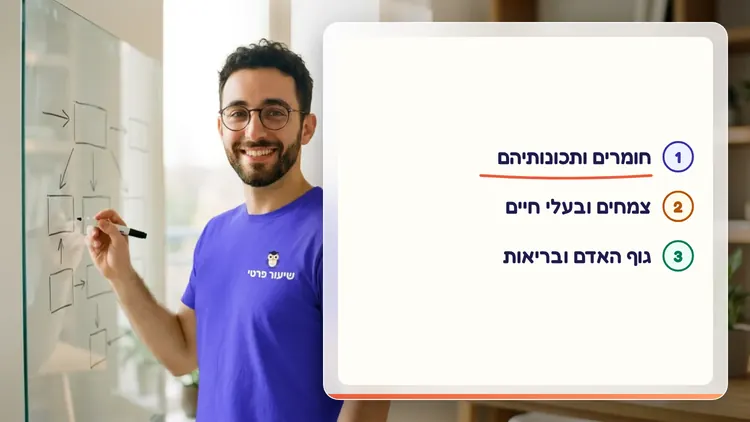
The teacher explains, writes and draws on a shared board, and your child solves along on the same board.
Snap a photo of a worksheet or homework and work through it, one problem at a time.
Parents get a report: study time, what went well and what needs more practice.
Lesson rules
- Just Learning
- Prepare, Don't Copy
FAQ
- How does a private Biology lesson work?
- Your child picks Biology and a topic, then talks with the teacher out loud. The teacher checks what they already know, explains in a way that suits them, writes and draws on the board, and lets them solve on their own with hints until it clicks.
- Does the teacher help analyze biology experiments?
- Yes. The teacher explains how to identify dependent and independent variables, how to read a graph and how to phrase a conclusion.
- My child struggles with genetics problems using Punnett squares. Can the teacher help?
- Yes. The teacher draws the grid on the board and asks the student to first write each parent's gametes. Then the student fills in the boxes and works out the ratios themselves. When something doesn't add up, the teacher asks which allele is dominant, and the student finds the mistake on their own.
- How do I start for free?
- Sign in with Google or a code sent to your email, enter your child's name and grade, and the lesson starts right away. Every family gets 45 free lesson minutes in any subject, counted by actual lesson time, with no credit card. Then choose a paid plan and cancel anytime.
- What device do I need?
- Any computer, tablet or phone with a browser and a microphone. You can also install the site as an app on your home screen.
- Can I get help with homework and tests?
- Yes. Snap a photo of a homework page, and the teacher works through it with your child, one problem at a time. Add a test to the test calendar and get a day-by-day study plan leading up to it.
More subjects
Want to try it?
Sign in, enter your child's name and grade, and the lesson begins. 45 free lesson minutes, no credit card.
Start for freeShiur Prati with AI: what it is and how it works