Private Chemistry Tutor Online with AI
Private Chemistry lessons with an AI teacher: your child talks with the teacher out loud, and the teacher explains and draws on a shared board, step by step, following what they're learning in class.
Teacher: Noam
- Course updated 11/2026
- Hebrew, and 5 more languages
- 1 level: High School (Grades 10–12)
- 23 lessons · about 14 hours of lessons
Chemistry
Private Chemistry lessons with an AI teacher: your child talks with the teacher out loud, and the teacher explains and draws on a shared board, step by step, following what they're learning in class.
23 lessons · 5 modules · Live private lesson with the teacher on the board
What you'll learn
- 037381 — Bonding, Structure and Stoichiometry
- 037381 — Redox, Acids and Bases
- 037381 — Food Chemistry, Energetics, Rate and Inquiry Lab
- 037283 — Sugars, Equilibrium, Lab and Electives
- 037381 — Exam Technique
Related topics
What's included
- Live 1:1 lessons with an AI tutor on a shared board
- 14 hours of live one-on-one lessons
- 23 lessons on a shared board, each with a clear goal
- Practice and a understanding check in every lesson
- A summary after every lesson, saved in the history
- A completion certificate for each level
- Computer, tablet or phone
- Hebrew, plus 5 more languages
Course plan
1 level · 5 modules · 23 lessons · 14 hr 20 min total
בגרות 5 יח"לChemistry Bagrut 5 Units5 modules • 23 lessons • 14 hr 20 min
Mapped to exam: בגרות כימיה 5 יח"ל — שאלון 037381 (55%), מעבדת חקר 037388 (15%), הערכה בית ספרית 037283 (30%)
037381 — Bonding, Structure and Stoichiometry6 lessons • 3 hr 45 min
- 1Atomic Structure and Periodic TrendsTrial lessonabout 35 min
- 2Ionic and Metallic Bondingabout 35 min
- 3Covalent Bonds, Lewis Structures and Molecular Shapeabout 40 min
- 4Intermolecular Forces and Propertiesabout 40 min
- 5The Mole, Molar Mass and Formulasabout 35 min
- 6Concentration, Gas Volume and Limiting Reagentabout 40 min
037381 — Redox, Acids and Bases4 lessons • 2 hr 35 min
- 7Oxidation Numbers and Electron Transferabout 35 min
- 8Oxidizer Strength and Balancing Redoxabout 40 min
- 9Acids, Bases and pHabout 40 min
- 10Neutralization and Titrationabout 40 min
037381 — Food Chemistry, Energetics, Rate and Inquiry Lab5 lessons • 3 hr 5 min
- 11Vitamins and Minerals: Structure and Solubilityabout 35 min
- 12Fatty Acids and Triglyceridesabout 40 min
- 13Energy in Reactions: ΔH and Bond Energiesabout 40 min
- 14Reaction Rate and Activation Energyabout 35 min
- 15Inquiry Lab: Analyzing Results and Drawing Conclusionsabout 35 min
037283 — Sugars, Equilibrium, Lab and Electives6 lessons • 3 hr 35 min
- 16Monosaccharides and Disaccharidesabout 35 min
- 17Polysaccharides: Starch, Glycogen, Celluloseabout 35 min
- 18Chemical Equilibrium and Le Chatelierabout 40 min
- 19Entropy and Spontaneityabout 35 min
- 20Inquiry Lab: From Question to Experimental Designabout 35 min
- 21Elective Module: Polymers and Structure-Propertyabout 35 min
037381 — Exam Technique2 lessons • 1 hr 20 min
- 22Part One: Multiple Choice and Scientific Articleabout 40 min
- 23Part Two: Choosing and Answering Open Questionsabout 40 min
What you need
- No prior knowledge needed for beginner level: the teacher checks what you already know and starts from there
- A computer, tablet or phone with a microphone, and a browser
Who it's for
- Teens and adults who want to understand the subject in depth
Exams and certifications
- בגרות 5 יח"ל: בגרות כימיה 5 יח"ל — שאלון 037381 (55%), מעבדת חקר 037388 (15%), הערכה בית ספרית 037283 (30%)
What you learn in Chemistry
Taught in: High schoolBagrut: Elective · 5 unitsOfficial Bagrut Syllabus: Exam Papers, Topics & Structure
High school · Grades 10–12
- Atomic structure and the periodic table
- Chemical bonding
- Stoichiometry and the Mole
- Oxidation-Reduction
- Acids and Bases
- Equilibrium
- Food Chemistry / Organic Chemistry
- Lab
How we teach Chemistry
In chemistry, you need to see what's happening at the particle level. The teacher draws the structure of atoms and molecules, balances reactions with the student and explains the calculations, so they understand why a reaction happens instead of just memorizing it.
A Grade 11 student gets the reaction of hydrogen and oxygen forming water and writes H2 plus O2 gives H2O. The teacher asks them to count the oxygen atoms on each side on the board. The student sees two on the left and only one on the right. They try changing the formula to H2O2, and the teacher asks whether that's still water. Then comes the hint: you can only change the coefficients, not the subscripts. The teacher draws small circles for each atom, and the child moves them around until they figure out on their own that two hydrogen molecules and one oxygen molecule give two water molecules. Finally, the teacher has them balance the combustion of methane alone, to show the method works for a more complex reaction too.
Chemistry relies on a new language of symbols, formulas, and units, and a student who misses the basics of moles and chemical bonds struggles with everything that comes after. From the outside, it looks like general confusion. The parent summary spells out where the student got stuck, for example writing a formula, converting grams to moles, or understanding acids and bases. Molarity calculations are a common weak spot.
More courses in this track
Physics
with Noa
Live 1:1 lesson with an AI teacherabout 15 hours24 lessonsHigh School (Grades 10–12)BagrutBiology
with Noa
Live 1:1 lesson with an AI teacherabout 15 hours24 lessonsHigh School (Grades 10–12)Bagrut
Your teacher
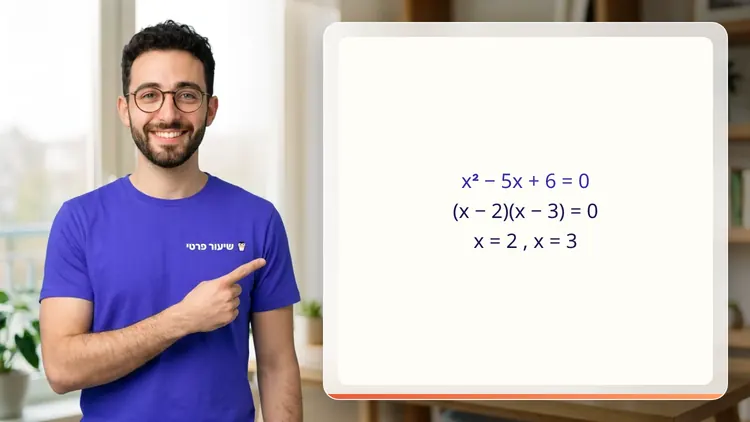
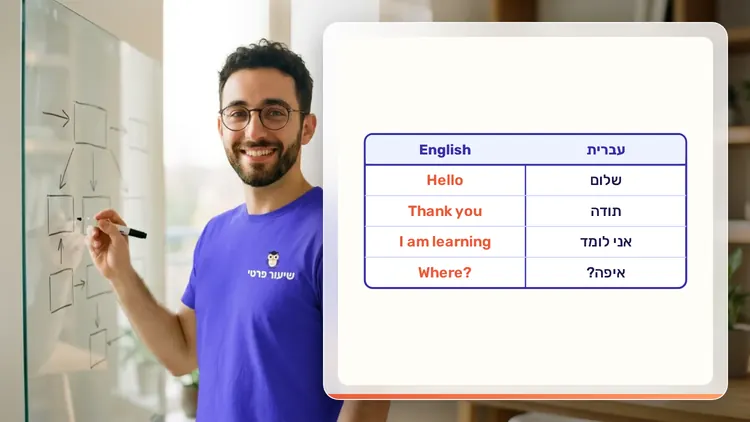
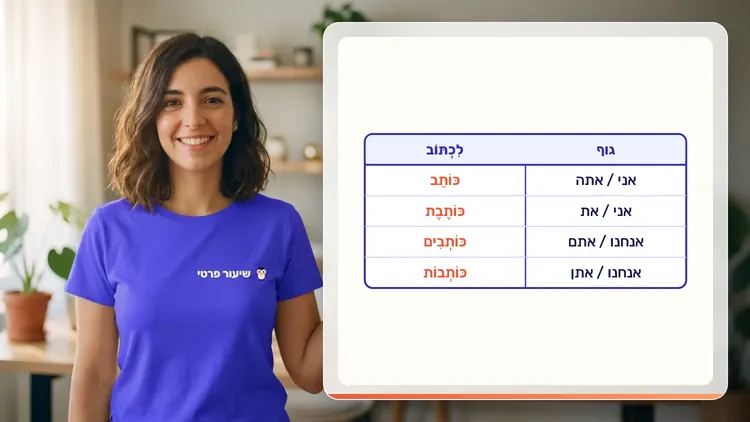
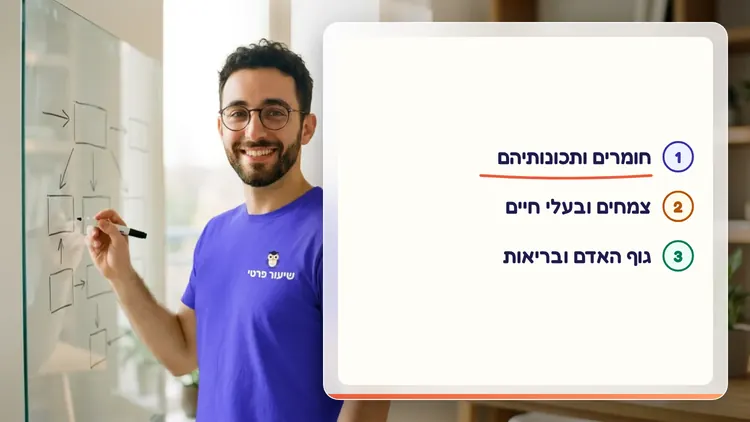
 NoamAI private tutor, in a live lesson on a shared board
A private AI teacher who teaches in a live conversation: asks, listens, draws on the board, and lets you solve it yourself with hints. Remembers what you've learned and starts each lesson where you left off.
What's a lesson like?
Your child talks with the teacher out loud, like a video call, and asks about anything unclear.
The teacher explains, writes and draws on a shared board, and your child solves along on the same board.
Snap a photo of a worksheet or homework and work through it, one problem at a time.
Parents get a report: study time, what went well and what needs more practice.
Lesson rules
- Just Learning
- Lab Safety
- Prepare, Don't Copy
FAQ
- How does a private Chemistry lesson work?
- Your child picks Chemistry and a topic, then talks with the teacher out loud. The teacher checks what they already know, explains in a way that suits them, writes and draws on the board, and lets them solve on their own with hints until it clicks.
- Does the teacher help with balancing reactions and mole calculations?
- Yes. The teacher goes through every step with the student, draws on the board and lets them solve the next problem on their own.
- Does the teacher help with understanding chemistry labs and writing lab reports?
- Yes. The student can snap a photo of the lab sheet, and the teacher goes over the aim, variables, and observations with them. The teacher asks what the theory predicted and why the result came out differently, and helps them write a well-reasoned conclusion, exactly as required in the lab section of the Bagrut.
- How do I start for free?
- Sign in with Google or a code sent to your email, enter your child's name and grade, and the lesson starts right away. Every family gets 45 free lesson minutes in any subject, counted by actual lesson time, with no credit card. Then choose a paid plan and cancel anytime.
- What device do I need?
- Any computer, tablet or phone with a browser and a microphone. You can also install the site as an app on your home screen.
- Can I get help with homework and tests?
- Yes. Snap a photo of a homework page, and the teacher works through it with your child, one problem at a time. Add a test to the test calendar and get a day-by-day study plan leading up to it.
More subjects
Want to try it?
Sign in, enter your child's name and grade, and the lesson begins. 45 free lesson minutes, no credit card.
Start for freeShiur Prati with AI: what it is and how it works