Private Industrial Engineering and Management Tutor Online with AI
Private Industrial Engineering and Management lessons with an AI teacher: your child talks with the teacher out loud, and the teacher explains and draws on a shared board, step by step, following what they're learning in class.
Teacher: Noa
- Course updated 11/2026
- Hebrew, and 5 more languages
- 1 level: High School (Grades 10–12)
- 24 lessons · about 14 hours of lessons
Industrial Engineering and Management
Private Industrial Engineering and Management lessons with an AI teacher: your child talks with the teacher out loud, and the teacher explains and draws on a shared board, step by step, following what they're learning in class.
24 lessons · 5 modules · Live private lesson with the teacher on the board
What you'll learn
- Questionnaire 803381 · Part A: Engineering Economics
- Questionnaire 803381 · Part B: Intro to Probability and Statistics
- Questionnaire 803381 · Part C: Applied Statistics
- Questionnaire 803283: Operations Systems in the Organization
- Exam preparation — Questionnaire 803381
Related topics
What's included
- Live 1:1 lessons with an AI tutor on a shared board
- 14 hours of live one-on-one lessons
- 24 lessons on a shared board, each with a clear goal
- Practice and a understanding check in every lesson
- A summary after every lesson, saved in the history
- A completion certificate for each level
- Computer, tablet or phone
- Hebrew, plus 5 more languages
Course plan
1 level · 5 modules · 24 lessons · 14 hr total
בגרות 5 יח"לOperations Management — Bagrut 5 Units5 modules • 24 lessons • 14 hr
Mapped to exam: בגרות הנדסת תעשייה וניהול 5 יח"ל — שאלון 803381 (חיצוני 70%) ושאלון 803283 (הערכה חלופית 30%)
Questionnaire 803381 · Part A: Engineering Economics6 lessons • 3 hr 20 min
- 1Time value of money: simple and compound interestTrial lessonabout 30 min
- 2Nominal vs. effective interest and compounding periodsabout 30 min
- 3Uniform series: discount factorsabout 35 min
- 4Loans and amortization: annuity vs. equal principalabout 35 min
- 5Comparing alternatives: NPV and equivalent annual worthabout 35 min
- 6IRR, payback period and break-evenabout 35 min
Questionnaire 803381 · Part B: Intro to Probability and Statistics6 lessons • 3 hr 20 min
- 7Descriptive statistics: frequency distributions and chartsabout 30 min
- 8Measures of central tendency and dispersionabout 30 min
- 9Basic probability and combinatoricsabout 35 min
- 10Conditional probability, independence and Bayesabout 35 min
- 11Discrete random variables and the binomial distributionabout 35 min
- 12Normal distribution and z-scoresabout 35 min
Questionnaire 803381 · Part C: Applied Statistics7 lessons • 4 hr 10 min
- 13Sampling and the sampling distribution of the meanabout 30 min
- 14Confidence intervals for mean and proportionabout 35 min
- 15Hypothesis testingabout 40 min
- 16Correlation and linear regressionabout 35 min
- 17Statistical process control: X-bar and R chartsabout 40 min
- 18p-charts and process capabilityabout 35 min
- 19Demand forecasting: moving average and exponential smoothingabout 35 min
Questionnaire 803283: Operations Systems in the Organization4 lessons • 2 hr 30 min
- 20The organization as an operations system: processes and bottlenecksabout 35 min
- 21Project management: Gantt charts and critical pathabout 40 min
- 22Supply chain and inventory: EOQ and reorder pointabout 40 min
- 23Performance task: analyzing a real operations systemabout 35 min
Exam preparation — Questionnaire 8033811 lesson • 40 min
- 24Exam technique for 803381: time, question choice and scoringabout 40 min
What you need
- No prior knowledge needed for beginner level: the teacher checks what you already know and starts from there
- A computer, tablet or phone with a microphone, and a browser
Who it's for
- Teens and adults who want to understand the subject in depth
Exams and certifications
- בגרות 5 יח"ל: בגרות הנדסת תעשייה וניהול 5 יח"ל — שאלון 803381 (חיצוני 70%) ושאלון 803283 (הערכה חלופית 30%)
What you learn in Industrial Engineering and Management
Taught in: High schoolBagrut: Technology major · 5 unitsOfficial Bagrut Syllabus: Exam Papers, Topics & Structure
High school · Grades 10–12
- Production and Operations Management
- Operations Research
- Statistics and Quality Control
- Economics and Management
- Information Systems
- Project Management
How we teach Industrial Engineering and Management
Industrial Engineering and Management is a 5-unit high school technology major that teaches how an organization produces, plans and decides. Students learn production and operations management: production lines, bottlenecks and inventory. In operations research, they build a linear programming model and solve it with a graph. In statistics and quality control, they calculate the mean and standard deviation and draw a control chart. Economics and management, information systems, and project management with Gantt charts and the critical path round it out. The teacher takes a familiar example, like a neighborhood bakery or a bike assembly line, and puts it on the board. Then the student turns the story into data and a model. Dry concepts gain meaning, and the student learns to justify a decision, not just calculate.
A small project: six activities for building an exhibition booth, each with a duration and dependencies. The student needs to find the critical path. The teacher draws a network on the board: circles for activities, arrows for dependencies, and a duration above each circle. At first, the student just adds up all the times. The hint: which activities can run in parallel, and what's actually holding up the finish? The student works out the early and late start times for each activity and discovers that two of them have slack. They mark in red the chain with no slack at all. Then the teacher asks what happens if the painting is delayed by two days, and the student works out whether the opening date moves. The teacher also asks them to draw the project as a Gantt chart and check that the result matches.
The subject looks easy because the examples are everyday ones. The challenge is turning a story into a model: identifying decision variables, constraints and an objective function. Quality-control statistics also catch many students off guard. In the summary, parents see which tool their child practiced (Gantt charts, linear programming or control charts) and whether they already justify decisions on their own. The summary also includes the problem they solved, so you can ask them to explain it at home.
More courses in this track
Physics
with Noa
Live 1:1 lesson with an AI teacherabout 15 hours24 lessonsHigh School (Grades 10–12)BagrutChemistry
with Noam
Live 1:1 lesson with an AI teacherabout 14 hours23 lessonsHigh School (Grades 10–12)BagrutBiology
with Noa
Live 1:1 lesson with an AI teacherabout 15 hours24 lessonsHigh School (Grades 10–12)Bagrut
Your teacher
 NoaAI private tutor, in a live lesson on a shared board
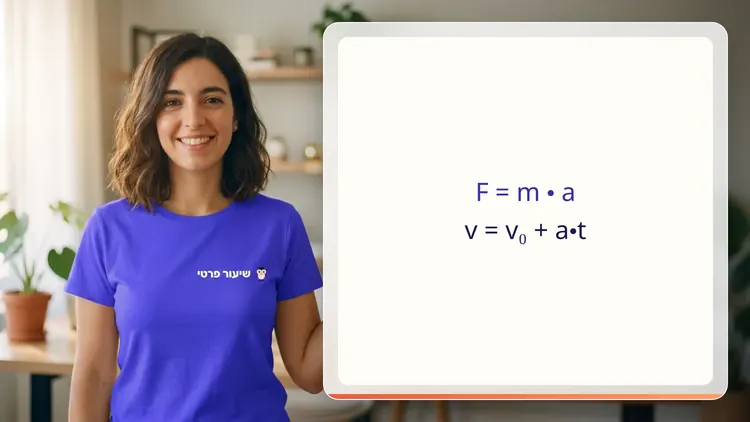
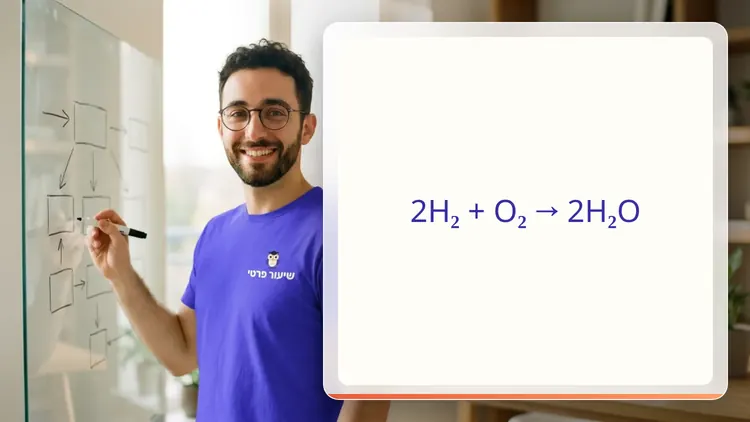
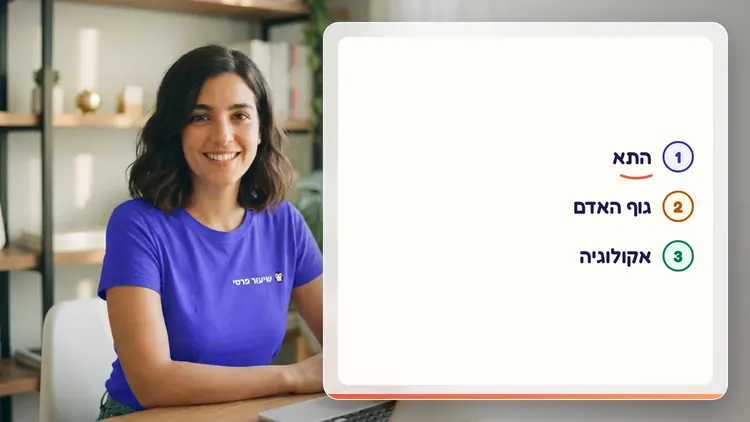
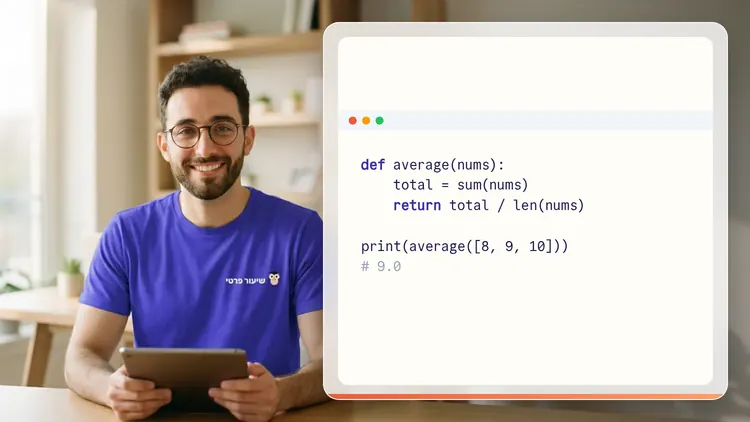
A private AI teacher who teaches in a live conversation: asks, listens, draws on the board, and lets you solve it yourself with hints. Remembers what you've learned and starts each lesson where you left off.
What's a lesson like?
Your child talks with the teacher out loud, like a video call, and asks about anything unclear.
The teacher explains, writes and draws on a shared board, and your child solves along on the same board.
Snap a photo of a worksheet or homework and work through it, one problem at a time.
Parents get a report: study time, what went well and what needs more practice.
Lesson rules
- Just Learning
- Prepare, Don't Copy
FAQ
- How does a private Industrial Engineering and Management lesson work?
- Your child picks Industrial Engineering and Management and a topic, then talks with the teacher out loud. The teacher checks what they already know, explains in a way that suits them, writes and draws on the board, and lets them solve on their own with hints until it clicks.
- My child can't build a linear programming model. How does the teacher help?
- The teacher reads the problem with the student and first asks what's actually being decided. From there, they define the variables. Then each sentence in the problem becomes a constraint on the board, and they sketch the feasible region and check its vertices. The student plugs in the values and finds the optimal solution.
- Do the lessons also cover quality control and control charts?
- Yes. The teacher gives the student weight measurements of packages from a production line. The student calculates the mean, the standard deviation and the upper and lower control limits. Then they draw the chart together, and the student decides whether the process went out of control and what's worth checking.
- How do I start for free?
- Sign in with Google or a code sent to your email, enter your child's name and grade, and the lesson starts right away. Every family gets 45 free lesson minutes in any subject, counted by actual lesson time, with no credit card. Then choose a paid plan and cancel anytime.
- What device do I need?
- Any computer, tablet or phone with a browser and a microphone. You can also install the site as an app on your home screen.
- Can I get help with homework and tests?
- Yes. Snap a photo of a homework page, and the teacher works through it with your child, one problem at a time. Add a test to the test calendar and get a day-by-day study plan leading up to it.
More subjects
Want to try it?
Sign in, enter your child's name and grade, and the lesson begins. 45 free lesson minutes, no credit card.
Start for freeShiur Prati with AI: what it is and how it works